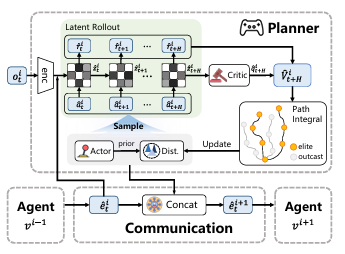
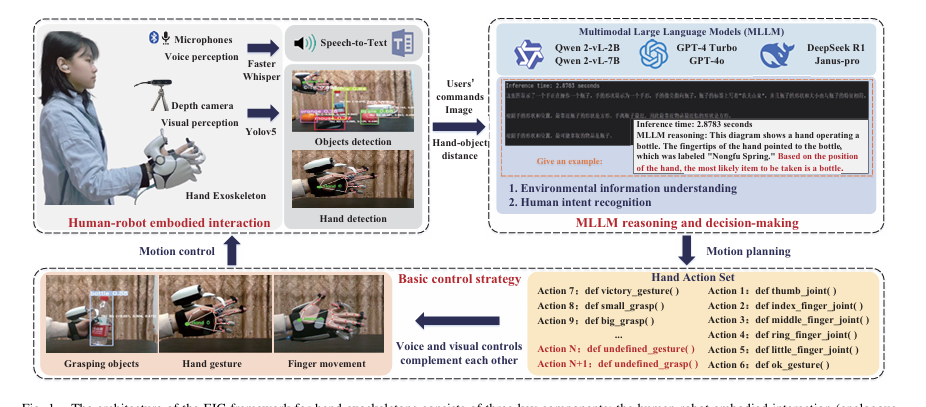
@inproceedings{guo2026multirobot,title={Empowering multi-robot cooperation via sequential world models},author={Zhao, Z. and Guo, Honglei and Chen, S. and Xu, K. and Jiang, B. and Zhu, Y. and Zhao, D.},booktitle={International Conference on Learning Representations},year={2026},pages={13262--13280},}
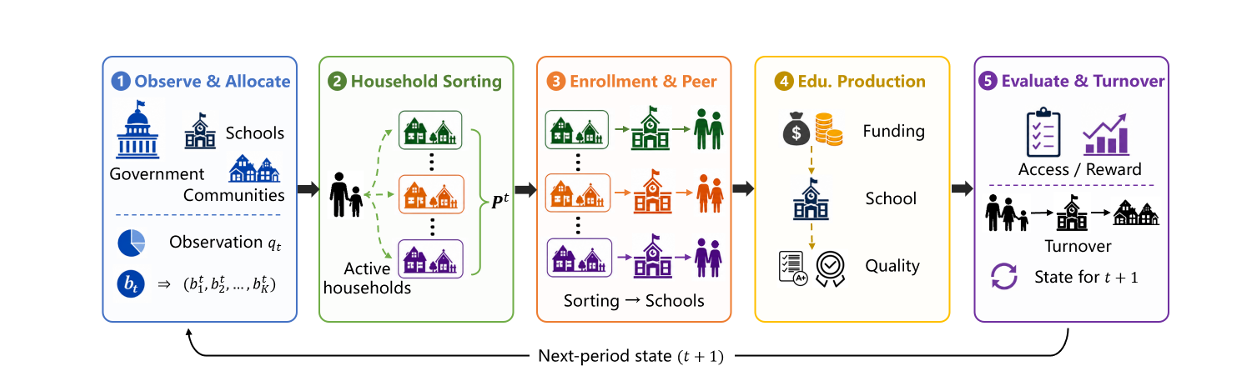
Allocating public-school investment effectively and fairly is difficult when school access depends on residence. School improvements can raise nearby housing demand and prices, reshape enrollment, and potentially limit access for lower-income households. These effects evolve as residential sorting changes school composition, quality, and future investment needs. We address this gap with a dynamic multi-agent framework that links government investment, household sorting, housing prices, population turnover, enrollment, and evolving school quality. A government planner uses reinforcement learning to identify multiyear allocation policies that account for household responses while balancing aggregate educational access and equity.
@misc{guo2026education,title={Learning Long-Term Educational Investment Policies under Residential Sorting},author={Guo, Honglei and Chen, Shuo and Bi, Mingjie and Sun, Zeyang and Wang, Xiaoxi and Zhao, Yuhan},year={2026},note={arXiv preprint arXiv:2608.07295},}
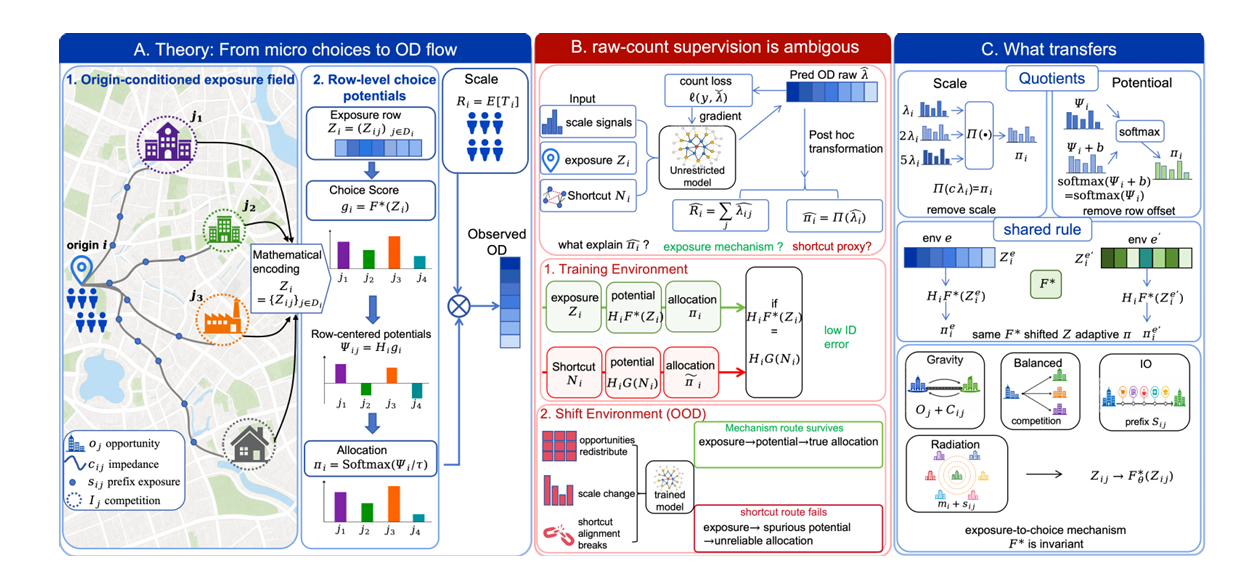
Origin-destination (OD) flow prediction is central to urban analytics, yet deep models trained on raw counts remain vulnerable to distribution shift. The core problem is that raw count supervision cannot distinguish transferable choice mechanisms from environment-specific shortcuts. We propose OpFlow, a mechanism-constrained framework that learns row-centered choice potentials and reconstructs flows by combining the induced allocation with a separately calibrated origin scale. Controlled synthetic shifts and real-world experiments show that OpFlow improves robustness under environment shifts.
@misc{guo2026opflow,title={OpFlow: Learning Opportunity-Conditioned Choice Potentials for Robust OD Flow Prediction},author={Liu, Changjian and Gao, Yong and Wang, Yuqing and Su, Leyi and Guo, Honglei and Wang, Zhiyang and Wang, Xiaoyu and Zhang, Fan},year={2026},note={arXiv preprint arXiv:2607.03200},}
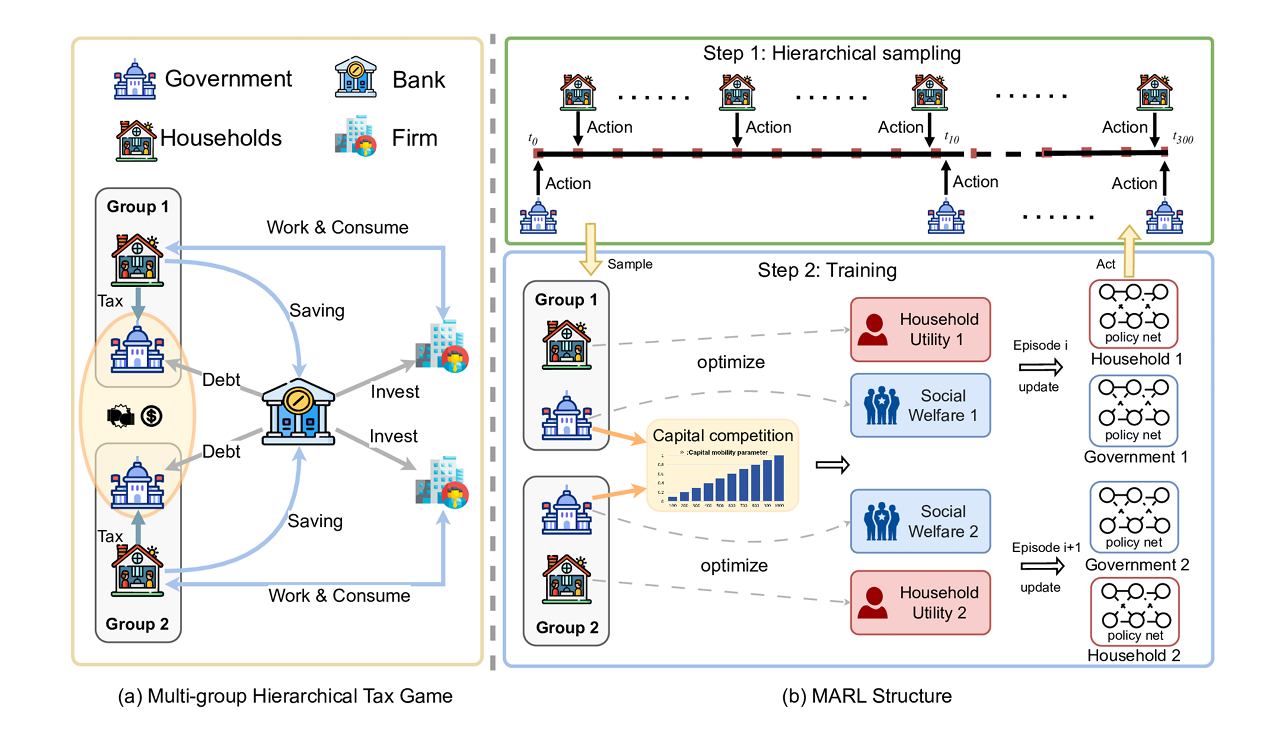
Reinforcement learning has increasingly been applied to economic decision-making, including taxation, public spending, and labor supply. However, existing models typically consider only a single government-household group, overlooking strategic interactions among competing governments. We formulate taxation as a hierarchical multi-group game and propose a bilevel multi-agent reinforcement learning framework with curriculum learning and a closed-loop sequential update mechanism to improve training stability and convergence. Experiments show that the proposed method learns stable and sustainable tax policies under inter-group competition.
@misc{guo2026taxgame,title={Hierarchical Multiagent Reinforcement Learning for Multi-Group Tax Game},author={Guo, Honglei and Zhao, Yuhan and Li, Yexin},year={2026},note={arXiv preprint arXiv:2605.04741},}
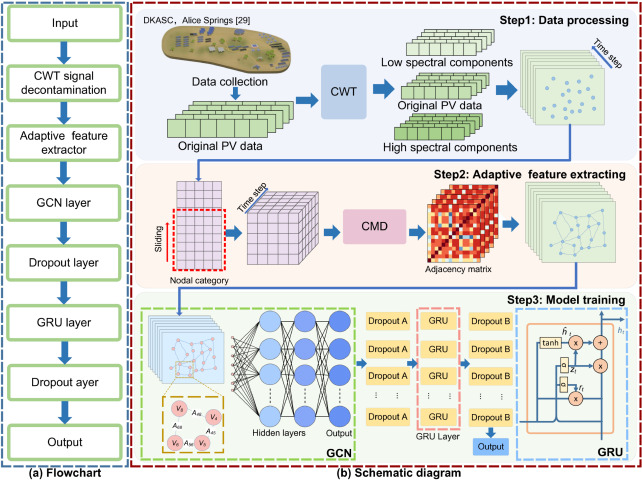
@article{guo2026energyx,title={High precision prediction of time-varying photovoltaic power based on dynamic adjacency matrix and temporal spectral graph convolution network},author={Guo, Honglei and Su, Z. and Wang, Z. and Zhan, G. and Liu, C. and Bu, L.},journal={Energy Conversion and Management: X},volume={30},pages={101676},year={2026},}
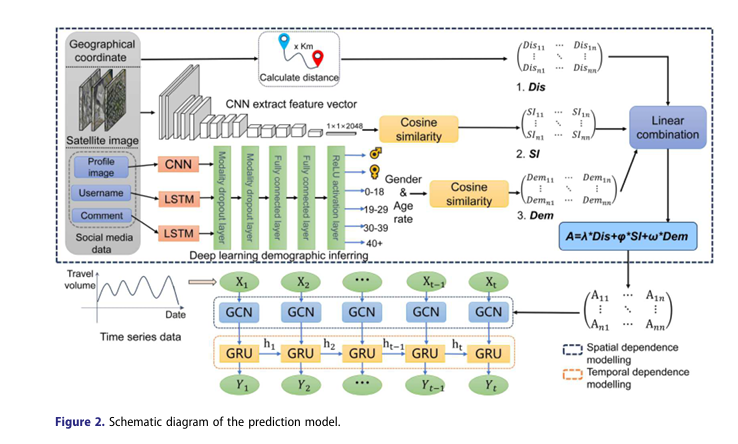
Integrating trajectory data and demographic characteristics: a trajectory semantic model for predicting travel flow and conducting interaction analysis
@article{guo2024trajectory,title={Integrating trajectory data and demographic characteristics: a trajectory semantic model for predicting travel flow and conducting interaction analysis},author={Liu, C. and Gong, S. and Su, H. and Chen, J. and Guo, Honglei and He, J. and Jing, C. and Liu, Y.},journal={International Journal of Digital Earth},volume={17},number={1},pages={2392842},year={2024},}